Hair shedding after an illness, stress, childbirth or weight loss needs a different response from gradual pattern thinning, a smooth bald patch or hair loss caused by scalp inflammation. By identifying the likely cause, completing the right assessment and comparing medication, procedures, devices and camouflage, you can choose treatment based on diagnosis rather than guesswork.
Key takeaways
- Diffuse shedding after illness, stress, surgery, childbirth, or weight loss can be temporary.
- Pattern hair loss needs a different plan from thyroid disease, iron deficiency, or scalp inflammation.
- Medicines, injections, light devices, and transplantation differ in evidence, timing, and commitment.
- Use gentle hair care and address diagnosed triggers while waiting for treatment results.
Is your hair shedding temporary, or is it progressive thinning?
Temporary shedding usually follows a trigger such as fever, major stress, surgery, childbirth, or rapid weight loss, then appears as diffuse hair fall about two to three months later. It often settles over the following months.
Pattern hair loss is more gradual: a widening part, receding temples, a thinner ponytail, or increasingly visible scalp points to progressive thinning rather than a short-lived shed.
| Pattern | What you notice | What it suggests |
|---|---|---|
| Temporary shedding | Hair falls from across the scalp without a clear bald patch, often after an illness or major stress | Telogen effluvium; investigate the trigger if shedding persists |
| Pattern hair loss | Gradual loss of density, a widening part, receding temples, or a smaller ponytail | Follicle miniaturisation requiring early assessment |
| Prompt review needed | Sudden patchy loss, eyebrow or eyelash loss, scalp pain, redness, scaling, pustules, crusting, shiny scarring, or rapid shedding | Alopecia areata, inflammation, infection, scarring loss, or another condition needing prompt care |
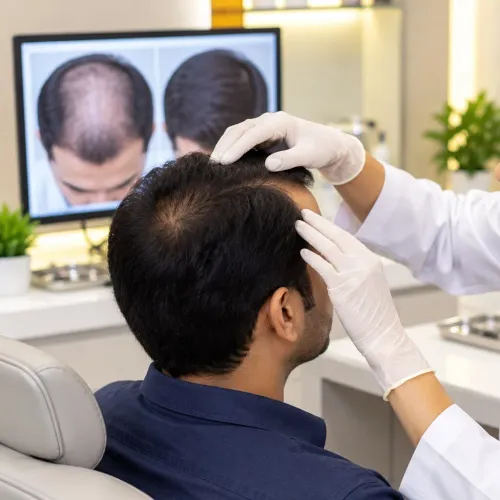
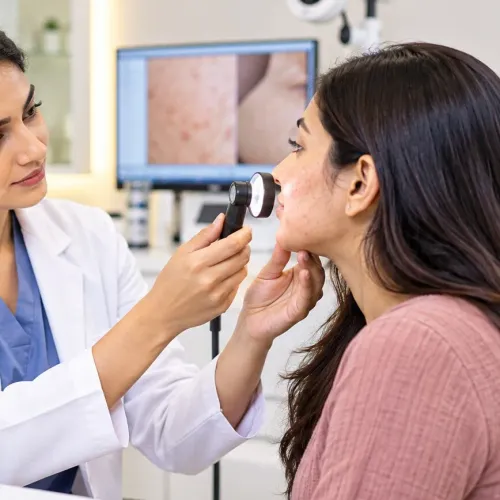
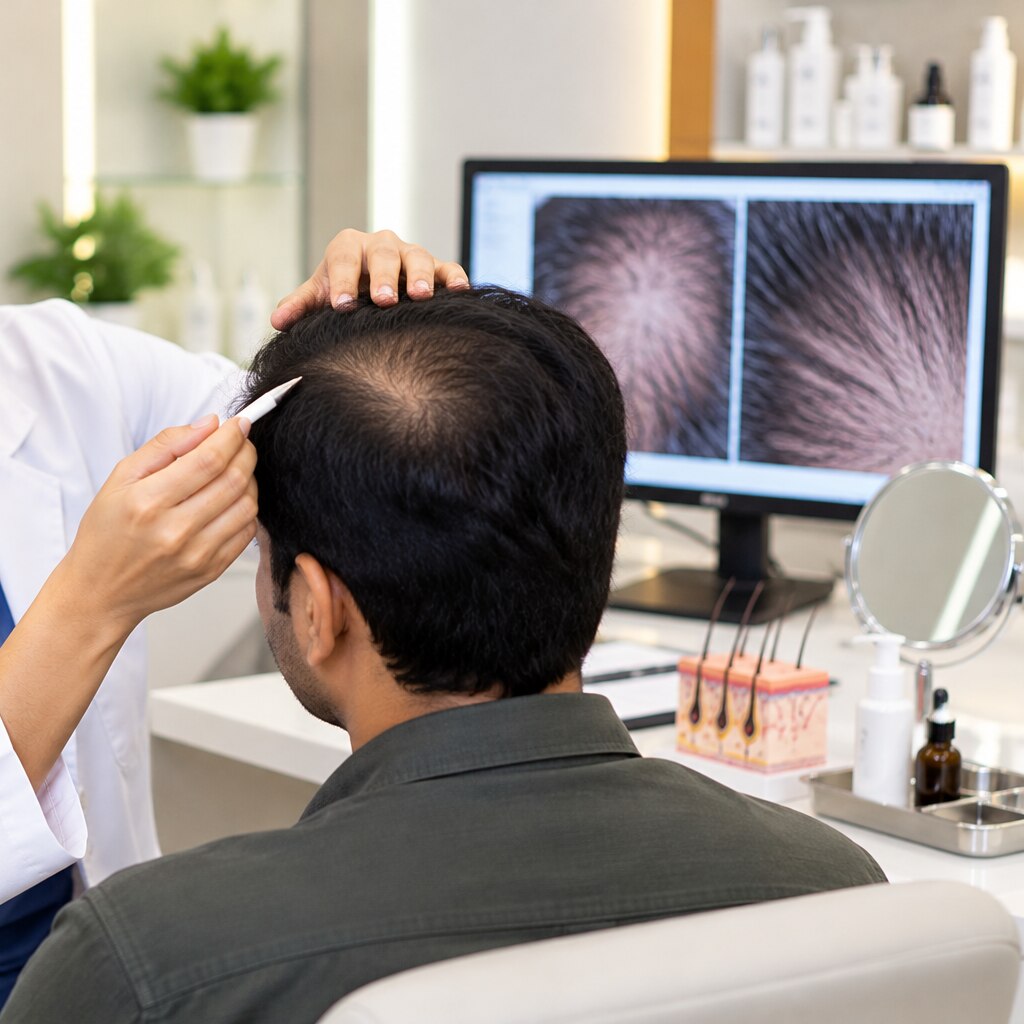
Hair loss is not one diagnosis. A proper assessment reviews the shedding timeline, family history, medicines, and recent illnesses, then examines the scalp and checks hair pull or density; dermoscopy can reveal miniaturised follicles or inflammation. Targeted tests can include a complete blood count, ferritin, thyroid-stimulating hormone, and vitamin B12 when indicated.
Which causes of hair loss need different treatment plans?
Different causes require different treatment plans: follicle miniaturisation, temporary shedding, autoimmune attack, traction, inflammation and nutritional or medical problems do not respond to the same treatment.
| Cause | Typical clue | Why the plan differs |
|---|---|---|
| Androgenetic alopecia | Gradual widening part, receding temples or thinner ponytail | Needs treatment that slows follicle miniaturisation and supports regrowth |
| Telogen effluvium | Diffuse shedding beginning 2–3 months after fever, surgery, childbirth, stress, rapid weight loss or deficiency | Focuses on finding and correcting the trigger |
| Alopecia areata | Sudden smooth round patches, sometimes eyebrow or eyelash loss | Requires assessment for autoimmune activity |
| Traction alopecia | Loss along the hairline after tight styles, extensions or braids | Removing tension early can prevent permanent follicle damage |
| Scarring alopecia or scalp inflammation | Pain, redness, scaling, pustules or shiny skin | Prompt treatment is needed before inflammation destroys follicles |
| Thyroid disease, iron deficiency, nutritional deficiency or medicines | Diffuse thinning or shedding with relevant symptoms or history | Treating the underlying cause takes priority |
| Hair-shaft damage | Breakage, split ends and uneven lengths rather than shedding from the root | Reducing heat, chemicals and friction protects the remaining hair |
A proper assessment starts with the shedding timeline, family history, recent illness, weight change, pregnancy, diet and every medicine or supplement. A clinician examines the scalp, checks hair density and may perform a hair-pull test or dermoscopy.
Targeted tests can include a complete blood count, ferritin, thyroid-stimulating hormone and vitamin B12 when your history or examination supports them. Seek prompt dermatology review for sudden patchy loss, eyebrow loss, scalp pain, pustules, scarring or rapid shedding.
Which medicines treat pattern hair loss and reversible triggers?
Pattern hair loss responds to follicle-directed treatment, but minoxidil will not correct iron deficiency, thyroid disease, alopecia areata, or scarring inflammation. Choose medication after confirming the cause and reviewing pregnancy plans, other medicines, blood pressure, and medical history.
| Option | When it applies | Trade-offs |
|---|---|---|
| Topical minoxidil 2% or topical minoxidil 5% | Common first treatment for female or male pattern loss | Apply continuously; early shedding, irritation, and unwanted facial or body hair can occur. Stopping gradually loses the treated benefit. |
| Oral minoxidil | Clinician-prescribed alternative when topical treatment is unsuitable or ineffective | Low blood pressure, ankle swelling, fast heartbeat, and increased body hair require monitoring. |
| Finasteride 1 mg | Mainly considered for male pattern hair loss under medical supervision | Reduced libido, erectile or ejaculatory problems, and mood changes are possible. Do not use during pregnancy; handling crushed tablets requires care around pregnancy. |
| Spironolactone | Selected women with female pattern loss, especially with androgen-related features | Avoid during pregnancy. Menstrual changes, breast tenderness, dizziness, and raised potassium can occur. |
| Deficiency treatment | Confirmed iron, vitamin B12, or other nutritional deficiency | Replace the documented deficiency rather than taking high-dose supplements without testing. |
| Scalp treatment | Inflammation, heavy scale, pustules, or diagnosed scalp disease | Treating the scalp condition may reduce shedding, but scarring alopecia needs prompt specialist care. |
A temporary minoxidil shed does not prove permanent worsening. Give treatment time, and do not delay assessment for scalp pain, burning, pustules, shiny scar-like skin, or rapidly expanding loss.
How do injections, light devices and hair transplantation compare?
For pattern hair loss, medication usually provides the foundation; injections, devices and transplantation address different gaps rather than replacing it. Minoxidil requires continuous use, while finasteride or spironolactone suits selected patients after reviewing risks. Neither treats every cause of shedding.
| Option | Main strength | Main limitation |
|---|---|---|
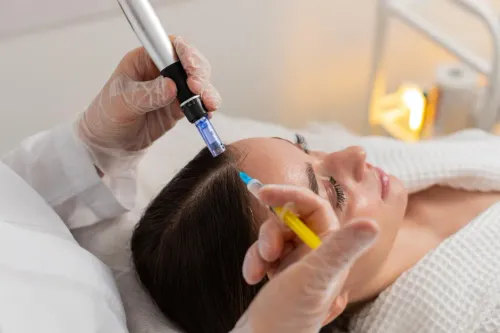
| PRP hair treatment | Uses your blood components as an injection-based adjunct | Protocols, injection schedules and evidence vary; it is not a standardized replacement for medication |
| GFC hair treatment | Offers another injection-based approach for selected thinning | Preparation methods and clinical evidence are less established than established medicines |
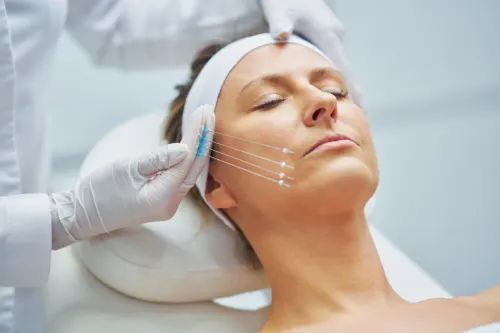
| Mesotherapy | Delivers a chosen formulation through scalp injections | Ingredients and dosing differ widely, so “mesotherapy” alone does not tell you what treatment you are receiving |
| Low-level light therapy | At-home or clinic device option with modest density gains in some pattern loss | Requires repeated use; device quality varies and it does not restore all lost hair |
| Hair transplantation | Redistributes follicles to create coverage in suitable areas | Donor follicles are finite, and untreated native hair can continue to miniaturise |
Choose among injections only after confirming the diagnosis and asking for the exact formulation, schedule, outcome measure and evidence. Low-level light therapy fits someone willing to maintain a repeated routine; it is a poor match for alopecia areata, scarring loss or unexplained shedding.
Choose transplantation when donor density, hair calibre and the future loss pattern support a durable design. Continue appropriate medication when advised to protect non-transplanted hair. Finesse Aesthetic can discuss PRP, GFC, mesotherapy and FUE, but the consultation should explain why one fits your diagnosis rather than present every option as equivalent.
Related services
HAIR & SCALP Mesotherapy Mesotherapy for scalp and hair is a specialized treatment designed to promote hair growth and improve hair health. |
SURGICAL TREATMENTS Transform your hairline and regain confidence with our advanced Hair Transplant - Scalp (FUE) procedure at Finesse Aesthetic. View service → |
What can you do while waiting for treatment to work?
Allow three to six months for early improvement from many hair-growth treatments, and six to 12 months for a fair assessment of density. Hair grows slowly, so stopping a treatment as soon as shedding eases can erase progress; minoxidil, for example, needs continued use to maintain its benefit.
Reduce extra damage while follicles recover:
- Wear loose hairstyles and avoid tight ponytails, braids, extensions and heavy clips; repeated pulling can cause traction hair loss.
- Limit bleaching, chemical straightening, curling irons and high-heat dryers, which increase breakage.
- Detangle gently from the ends upward, avoid vigorous scalp scratching and treat wet hair carefully.
- Eat regular, varied meals rather than taking high-dose supplements without confirmed deficiency.
These options improve appearance, not follicle health:
| Option | What it does | Limitation |
|---|---|---|
| Hair fibres | Adhere to existing hair to make the scalp look fuller | Water and heavy sweating can displace them |
| Scalp micropigmentation | Uses pigment dots to mimic closely cropped stubble | Does not regrow hair or treat inflammation |
| Wigs | Cover visible thinning immediately | Require fitting, cleaning and scalp comfort checks |
| Styling changes | Use a different part, shorter cut or added volume | Cannot reverse miniaturization or scarring |
Choose camouflage that suits your routine, but do not let it delay review of worsening loss, scalp symptoms or a treatment that is not producing the expected response.
Frequently asked questions
How can you tell whether hair shedding is temporary or progressive thinning?
Temporary shedding usually follows fever, major stress, surgery, childbirth, or rapid weight loss and appears two to three months later. Progressive thinning follows a continuing pattern, such as a widening part, receding hairline, or smaller crown area.
Which causes of hair loss need different treatment plans?
Pattern hair loss, temporary shedding after a trigger, nutritional deficiency, thyroid disease, scalp inflammation, traction, and scarring conditions require different evaluations and treatments. A clinician may review your history, examine the scalp, and order blood tests when appropriate.
Which medicines are used for pattern hair loss and reversible triggers?
Pattern hair loss is treated with options such as topical minoxidil and, for selected patients, prescription medicines. Reversible triggers require treatment of the cause, such as correcting a documented deficiency or managing thyroid disease.
How do injections, light devices, and hair transplantation compare?
Injections and light devices aim to support existing follicles and require repeated treatment. Hair transplantation redistributes follicles from a donor area and involves a procedure, recovery, and suitable donor hair.
What can you do while waiting for hair-loss treatment to work?
Avoid tight hairstyles and harsh chemical or heat treatments, eat enough protein, treat confirmed medical triggers, and track shedding with consistent photographs. Do not start supplements without evidence of deficiency.
Related services
HAIR & SCALP Platelet Rich Plasma (PRP) for Hair Growth is a revolutionary non-surgical procedure that harnesses the natural healing power of platelets from your... View service → |
HAIR & SCALP Say goodbye to flakes and scalp irritation with our advanced Anti-Dandruff Treatment at Finesse Aesthetic. View service → |
HAIR & SCALP GFC (Growth Factor Concentrate) GFC (Growth Factor Concentrate) for Hair Growth is an advanced therapy aimed at stimulating natural hair growth and improving hair density. View service → |
HAIR & SCALP Experience revitalized scalp health with our exclusive Keravive Scalp Facial at Finesse Aesthetic. View service → |