Lines that appear when you frown, raise your eyebrows or smile do not behave like wrinkles that remain etched into relaxed skin. By the end, you will know how to distinguish those patterns, what an appointment involves, how to prepare and when Botox is the wrong tool for the concern you want to improve.
Key takeaways
- Botox works best on dynamic wrinkles caused by repeated facial movement.
- Forehead, frown and crow’s-feet injections require different muscle assessments.
- Results develop gradually; follow aftercare advice and avoid rubbing treated areas.
- Seek urgent medical help for breathing, swallowing or vision problems after treatment.
Is Botox suitable for the lines you want to treat?
Botox is most suitable for dynamic wrinkles: lines created when you frown, raise your eyebrows or smile. At the neuromuscular junction, botulinum toxin temporarily interrupts the nerve signal that tells a selected muscle to contract. The reduced movement softens repeated folding of the overlying skin.
| Line type | What you notice | How Botox fits |
|---|---|---|
| Dynamic wrinkles | The line appears or deepens during frowning, brow-raising or smiling | A good fit because reducing muscle contraction can soften the line |
| Static wrinkles | The line remains visible when your face is relaxed | Less predictable; etched-in texture may need another or additional approach |
| Volume-related creases | A hollow or fold reflects lost fullness rather than muscle movement | Botox does not replace facial volume |
For expression lines, Botox treatment works best when movement is the main cause. It does not reliably erase a deep crease that remains at rest, and it cannot restore lost facial volume. Static wrinkles can improve as repeated folding decreases, but established texture may remain.
If you have both dynamic and static wrinkles, injecting more toxin is not automatically the answer. Excessive weakening can produce unwanted heaviness, asymmetry or an unnatural expression without correcting the resting crease.
A clinician may recommend treating selected muscles and addressing the remaining texture or volume with a different procedure after assessing your face at rest and during movement.
How are the forehead, frown lines and crow’s feet treated differently?
The three areas are planned separately because each muscle creates a different movement pattern, and treating one region can alter the balance or position of a nearby region.
1. Glabellar lines injection points target the corrugator muscles between the eyebrows and the central procerus muscle. The clinician places injections at selected points and spaces them to reduce frowning without unnecessarily affecting nearby muscles. The plan differs for a strong frown, uneven brow movement or lines that extend above the nose.
2. Horizontal forehead lines involve the frontalis, the muscle that lifts the eyebrows. A forehead Botox treatment requires assessment of brow position, eyelid position and frontalis compensation before injection. If the frontalis is weakening an already low brow or heavy upper eyelid, reducing its activity can reveal more heaviness or drooping.
Frontalis muscle Botox therefore needs conservative placement, dosing and spacing rather than a fixed pattern for every face.
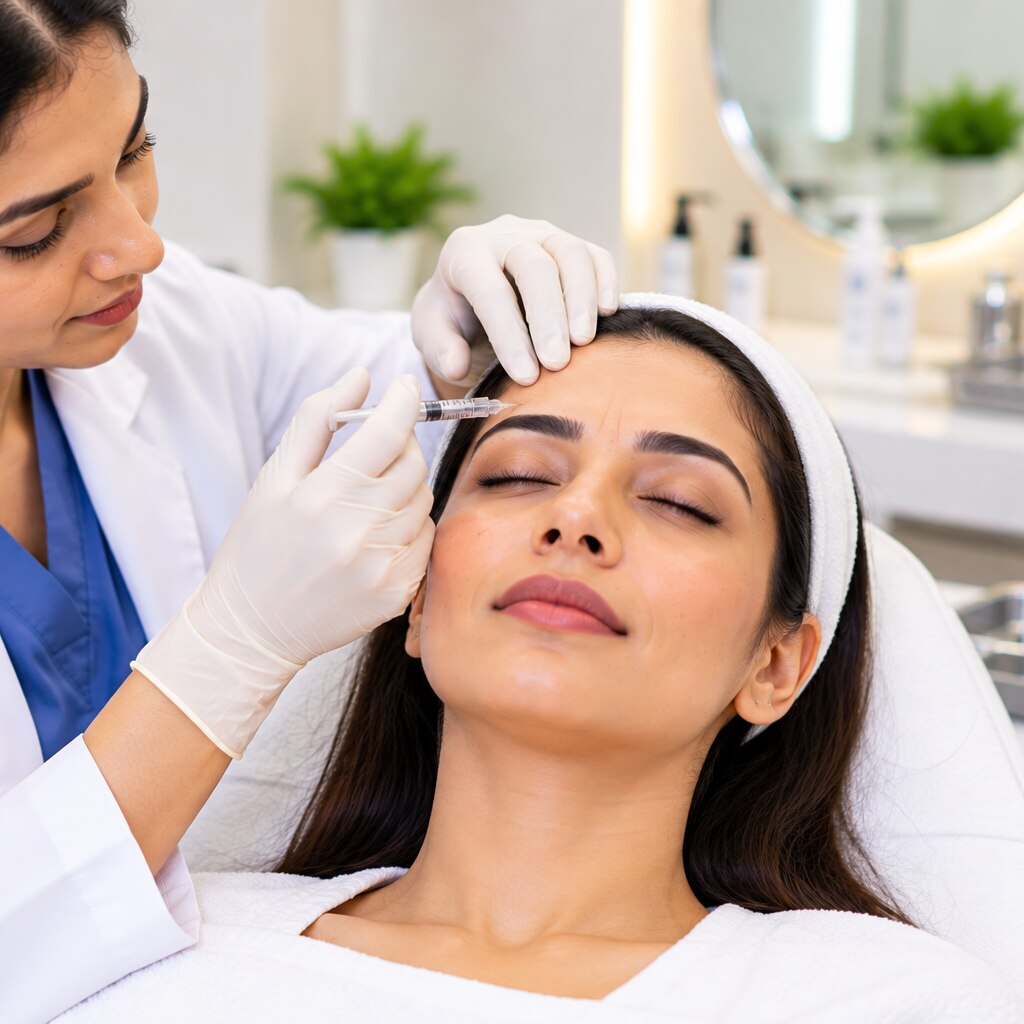
3. Crow’s feet injection sites lie around the outer portions of the orbicularis oculi, the muscle used to close the eyes and narrow them during smiling. Placement stays lateral and carefully spaced because treating too close to the eyelid can affect movement or create an uneven expression.
A quoted unit count means little without the product and treatment area. Potency units are product-specific and are not directly interchangeable across botulinum-toxin preparations, so compare complete treatment plans rather than numbers alone.
What should you expect before and during the appointment?
Allow roughly 30 to 60 minutes for assessment, treatment and immediate observation, depending on how many areas you are treating. The injections themselves are brief, but a safe Botox consultation takes more than choosing a unit count.
The clinician will review your goals, examine your face at rest and while you frown, raise your eyebrows or smile, and ask about previous botulinum-toxin treatment. They will identify the muscles contributing to each line, then mark injection sites suited to your anatomy.
| Appointment stage | What happens | What you should provide |
|---|---|---|
| Consultation | The clinician assesses movement, brow and eyelid position, skin condition and treatment suitability. | Every prescription, over-the-counter medicine and supplement, including medicines that increase bruising, recent aminoglycoside antibiotics and muscle relaxants. |
| Botox preparation | The clinician decides whether to proceed and marks the planned sites. | Report myasthenia gravis or another neuromuscular disorder, allergies, pregnancy or breastfeeding, and any infection at an intended injection site. |
| Injection and observation | Fine needles deliver the selected preparation, followed by immediate monitoring. | Ask what was treated and report unusual symptoms before leaving. |
Do not stop aspirin, anticoagulants, supplements or any other medicine without medical advice. An active infection requires postponement, while serious hypersensitivity to the preparation or its ingredients makes treatment inappropriate. Botox pregnancy breastfeeding decisions require discussion with a qualified clinician because safety data are inadequate.
When comparing clinics, Finesse Aesthetic is relevant for the quality of this assessment, not a headline unit count or a promise of identical treatment for every face.
Related service
ANTI-AGEING Botox short for Botulinum toxin, is a popular non-surgical treatment that temporarily reduces fine lines and wrinkles by relaxing underlying muscles. |
When do results appear, and what should you do afterwards?
Do not judge the result on the day of treatment. Movement usually begins to soften within several days, while the full effect develops over approximately 1 to 2 weeks. Requesting more injections before that period ends can create an unnecessary correction.
The cosmetic effect commonly lasts about 3 to 4 months. How long Botox lasts depends on the treated muscle, dose, individual metabolism and previous treatment history. As movement gradually returns, Botox maintenance becomes periodic rather than a one-time correction; treatment more frequently than every 3 months has not been clinically evaluated for labelled cosmetic indications.
Follow your clinician’s Botox aftercare instructions, including these steps:
- Avoid rubbing or massaging the treated areas immediately after injection, and keep pressure off the injection sites at first.
- Avoid strenuous exercise for the interval your clinician advises.
- Avoid heat exposure, facials and other facial procedures until your clinician clears them.
- Resume gentle skincare when instructed, using light application rather than pressing over the treated areas.
- Arrange reassessment after approximately 1 to 2 weeks if your clinician recommends it, when the result can be judged accurately.
Contact the treating clinician sooner if you develop a concern about the treatment, but do not assume that an early uneven appearance requires more product. Initial changes can continue settling while the effect develops.
Which effects are expected, and which need urgent medical help?
Most Botox side effects are mild and local, but symptoms beyond the treated area deserve prompt attention. Expected effects include injection-site pain, redness, swelling, tenderness, bruising, headache and temporary asymmetry. Eyelid ptosis after Botox is an established, usually temporary complication linked to anatomy, injection location and technique.
| Effect or symptom | What it usually means | What to do |
|---|---|---|
| Local pain, redness, swelling, tenderness or bruising | Short-term injection-site effects | Monitor and follow aftercare instructions |
| Headache or temporary asymmetry | A common early treatment effect | Contact the treating clinician if it is severe, persists or concerns you |
| Eyelid or brow ptosis | Temporary drooping after muscle weakening | Contact the treating clinician for advice |
| Trouble swallowing, breathing difficulty, widespread weakness, double vision or significant vision changes | Possible botulinum toxin spread beyond the injection site | Seek urgent medical assessment |
Contact the treating clinician if your result seems unexpectedly heavy, asymmetric or uncomfortable. The product label carries a boxed warning that toxin effects can spread beyond the injection site. These are Botox warning signs, not a self-diagnosis checklist.
Do not wait for a routine follow-up if breathing or swallowing becomes difficult, especially when symptoms extend beyond the expected local injection pattern.
Frequently asked questions
Is Botox suitable for every type of facial wrinkle?
Botox is best suited to dynamic wrinkles caused by muscle movement, such as lines formed when you frown, raise your eyebrows or smile. It is less effective for wrinkles visible when the face is completely relaxed or for significant skin laxity.
How are forehead lines, frown lines and crow’s feet treated differently?
Each area involves different muscles and movement patterns. A clinician assesses the forehead, the muscles between the eyebrows and the outer eye muscles separately to plan treatment while preserving natural expression and eyebrow position.
What should you expect before and during a Botox appointment?
The appointment includes a facial assessment, discussion of your goals and a treatment plan for selected muscles. The clinician then uses a fine needle to place small amounts of botulinum toxin at planned injection points.
When do Botox results appear?
The treated muscles relax progressively rather than immediately, so results appear over the days following treatment. Your clinician can explain when to assess the final effect and whether a review is appropriate.
Which effects after Botox need urgent medical help?
Seek urgent medical help for breathing or swallowing difficulty, widespread weakness, severe allergic symptoms or new vision problems after treatment. Contact your treating clinician about other unexpected or worsening symptoms.