Choosing a filler is not simply a matter of adding volume: the material, facial area, injection technique and amount used all affect the result and the risk. By the end, you will know how to prepare, compare alternatives, assess realistic outcomes and recognise when a filler problem needs urgent medical attention.
Key takeaways
- Match hyaluronic acid gel to adjustable volume and collagen stimulators to gradual support.
- Treat lips, cheeks and jawlines differently because each area has distinct anatomy and goals.
- Seek urgent medical help for severe pain, pale or mottled skin, or vision changes.
- Check the injector’s qualifications, product batch details, total cost and follow-up plan.
How to choose the filler and facial area that fit your goal
Match the filler to the change you want: immediate, adjustable volume calls for hyaluronic acid gel, while gradual tissue support calls for collagen stimulators. The facial area matters just as much; a lip treatment is not a smaller version of cheek or jawline contouring.
| Option | Result and timing | Practical fit |
|---|---|---|
| Hyaluronic acid gel | Immediate volume; temporary and dissolvable with hyaluronidase | Lips, cheeks, chin, and selected tear-trough cases |
| Calcium hydroxylapatite | Immediate structure with later collagen stimulation; firmer texture | Cheeks, chin, and jawline; not usually delicate, mobile lip tissue |
| Poly-L-lactic acid (PLLA) | Gradual collagen stimulation over multiple sessions; not instantly reversible | Broad cheek or temple volume loss when gradual change suits you |
| Other permanent fillers | Long-lasting or permanent correction; difficult to remove | Only after reviewing the specific product’s approval and risks |
Choose lips when you want border definition or fullness, cheeks for mid-face support, chin for projection, and jawline for definition. The nose and tear trough need particularly careful assessment because small volume errors can produce visible irregularity or serious complications.
A clinician should assess bone structure, skin laxity, facial movement, existing asymmetry, and your medical history before recommending a site. Hyaluronidase does not dissolve calcium hydroxylapatite, PLLA, or other non-HA materials, so “reversible” applies only to HA and is not an instant guarantee. Product approval also depends on the exact facial location.
What happens during a filler consultation and appointment
The first appointment should end with a treatment plan, not an automatic injection. The clinician checks:
- Your medical history and medication review, including previous filler, allergies, bleeding risks and recent infection.
- A facial assessment of proportions, skin quality, movement, laxity and the area you want changed.
- Your treatment goals and photographs taken from standard angles for planning and later comparison.
- Whether filler is appropriate, which product suits the site, and whether another treatment would produce a safer or more natural result.
If you proceed, the injector explains the product, proposed amount, injection points, expected changes, alternatives and material-specific risks before obtaining consent. Do not stop prescribed blood thinners without advice from the prescriber and injector. The skin is cleansed, and topical or local anaesthetic is used when appropriate.
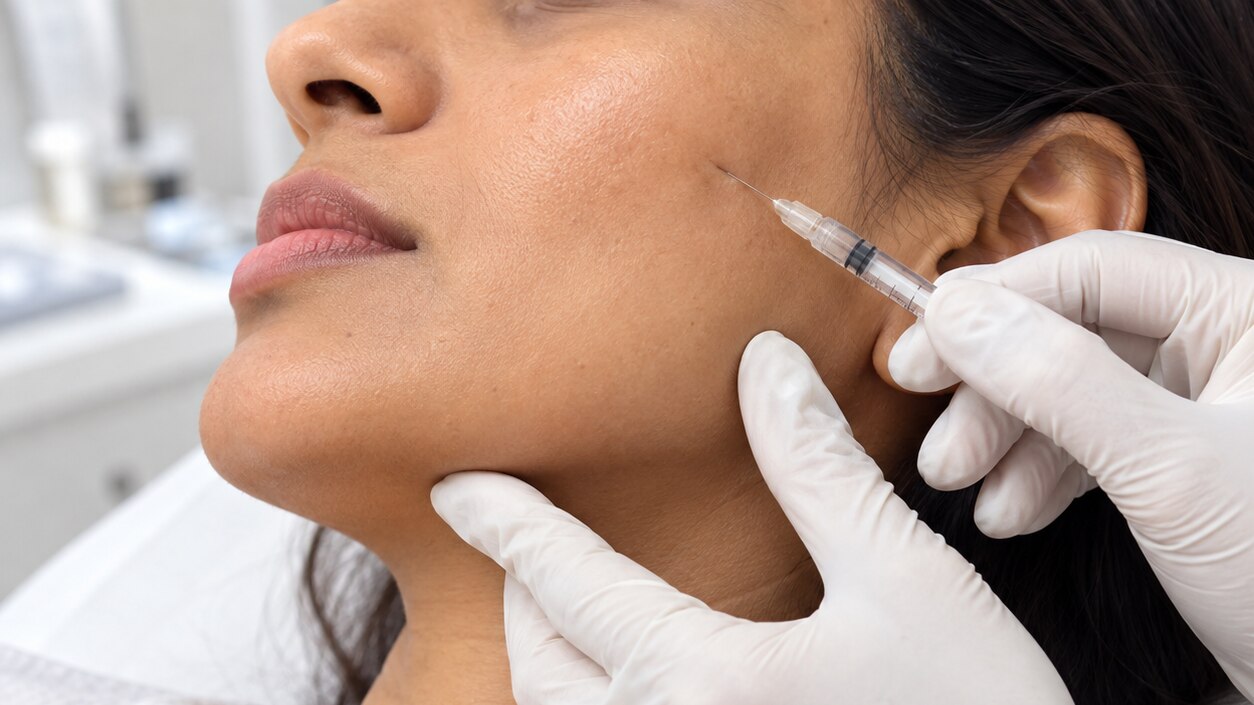
The injector marks the treatment area and may use a needle or cannula, depending on the site, product and required precision. Filler is placed through planned entry points in small amounts, with pauses to check symmetry and contour. A focused appointment can take around 30 to 60 minutes, including preparation.
You should remain under observation briefly after the injections. Immediate swelling, redness, tenderness or bruising can occur, and one side can look fuller than the other before the product settles. Do not judge the final contour while the area is freshly treated.
Recovery, side effects and emergency warning signs
Swelling and bruising, redness, tenderness and itching are common after injections. Swelling can be uneven and can make one side look overfilled; wait for it to settle before judging the result. Whether the injector uses a needle versus cannula does not remove these risks.
For the first 24 to 48 hours, avoid strenuous exercise, high heat and alcohol, and follow instructions about makeup and sleeping position.
| Symptom | Expected recovery | Needs immediate assessment |
|---|---|---|
| Pain | Mild tenderness that gradually eases | Increasing or severe pain, especially out of proportion |
| Skin appearance | Redness or bruising at injection points | Pale, white, dusky or mottled skin; coolness or blistering |
| Eyes and nerves | No new visual or neurological change | Vision loss, blurred vision, weakness, numbness, confusion or trouble speaking |
| General condition | Mild local discomfort | Fever, spreading redness, pus or rapidly worsening swelling |
Treat possible vascular occlusion as an emergency, not ordinary swelling. A blocked or compressed blood vessel can damage skin and, if it affects vessels supplying the eye or brain, cause permanent vision loss, stroke or death.
- Contact the treating clinician immediately for severe pain, color change, cool skin, blistering, or any new visual or neurological symptom.
- If you cannot reach the injector promptly, go to an emergency department or call local emergency services.
- Keep the product name, lot number and emergency contact instructions available; waiting to see whether symptoms settle can risk permanent injury.
How long results last and what filler can realistically change
Judge the result only after swelling, bruising and early asymmetry have settled. Compare your face with the agreed photographs, not with a filtered image, and ask whether the change improves facial proportions without making one feature look overfilled. A review can distinguish residual swelling from inadequate volume and decide whether to wait, adjust or dissolve.
| Option | What it can change | Longevity and trade-off |
|---|---|---|
| HA filler | Lips, cheeks, chin or jawline volume; modest structural projection | Temporary and generally reversible; maintenance depends on product, movement and site |
| CaHA or PLLA | Contour support or broader collagen-related improvement | Develops over time; not interchangeable with HA and less straightforward to reverse |
| Fat grafting | Larger, softer volume changes across selected areas | Uses your tissue; survival is variable and surgery is required |
| Implants | Fixed chin or cheek structural projection | Long-lasting, but involves surgery, recovery and implant-specific risks |
| Threads and HIFU | Limited lifting or skin-tightening effects | Do not replace substantial volume or bone-like projection; results and durability vary |
Plan maintenance from the actual return of the concern, not the product’s maximum advertised duration. HA can seem to fade sooner in mobile lips than in a stable contour area, while layering new filler over retained product can obscure asymmetry.
If the anatomy is unclear after previous treatment, ultrasound may help locate filler before adding more.
Permanent PMMA microspheres demand especially careful site, product and long-term risk assessment. Choose surgery when you need major structural change, and reject filler when it cannot deliver the scale or type of correction you want.
How to check safety, price and whether filler is the wrong choice
Do not judge safety by a low quote or the words “FDA-approved.” Verify the exact product, the proposed facial site, and the injector’s ability to handle complications.
- Ask to see sealed packaging before opening. Record the product name, expiry date, lot or batch number, and manufacturer; keep a photograph of the label.
- Check the injector’s medical registration number with the Tamil Nadu Medical Council or the relevant statutory register. Ask who will assess you if severe pain, skin discoloration, infection or visual symptoms develop, and obtain an emergency contact number.
- Ask whether the proposed use matches the product’s labeling for that facial location and age group. Approval applies to a specific product and use, not to every filler injection.
- Request an itemised price covering consultation, product, procedure, review appointments and complication management. A very low quote can conceal an unidentified product or inadequate follow-up.
- Ask whether previous filler remains. If the examination cannot establish the anatomy or old product, ultrasound or other imaging may be appropriate before adding more.
If the filler is hyaluronic acid, ask whether hyaluronidase is available and who would administer it. It does not dissolve calcium hydroxylapatite, poly-L-lactic acid or polymethylmethacrylate, and HA reversal can require repeat treatment.
Postpone treatment during active skin infection, unexplained facial swelling, pregnancy or breastfeeding, or when you cannot attend follow-up. Do not stop blood thinners without the prescribing clinician’s advice. Reject treatment when the injector will not show packaging, disclose the product, explain risks, or provide emergency access.
Finesse Aesthetic should be assessed by this same checklist, not by branding alone.
Related services
ANTI-AGEING Fillers Fillers are injectable substances designed to restore volume, smooth lines, and enhance facial contours. |
NON-SURGICAL FACIAL ENHANCEMENT Revitalize and redefine your facial contours with our advanced cheek enhancement treatments at Finesse Aesthetic. View service → |
Frequently asked questions
How do I choose the right filler and facial area?
Choose based on your goal: hyaluronic acid gel suits immediate, adjustable volume, while collagen stimulators provide gradual tissue support. Lips, cheeks and jawlines require different treatment plans.
What happens during a dermal filler consultation and appointment?
The consultation should cover your goals, medical history, facial anatomy, product choice, expected result, risks, cost and aftercare before treatment begins.
What side effects and warning signs should I watch for after filler?
Swelling, bruising, tenderness and redness can occur after treatment. Severe pain, pale or mottled skin, increasing discoloration or vision changes require urgent medical attention.
How long do dermal filler results last, and what can filler change?
Longevity depends on the product, treatment area and individual factors. Filler can add volume and improve contour, but it cannot replace surgery or correct every cause of facial change.
Related services
LIP Achieve fuller, beautifully contoured lips with our Lip Filler treatment at Finesse Aesthetic. View service → |
UNDER-EYE also known as tear trough filler or under-eye rejuvenation, is a non-surgical treatment designed to reduce the appearance of dark circles, hollows,... View service → |
NON-SURGICAL FACIAL ENHANCEMENT Experience luxurious lip enhancement at Finesse Aesthetic, where beauty meets precision. View service → |
NON-SURGICAL FACIAL ENHANCEMENT Transform your profile effortlessly with our Nose Enhancement Procedures at Finesse Aesthetic. View service → |