A transplant is suitable for some forms of permanent, patterned hair loss, but it is the wrong first step for sudden shedding, patchy loss or active scalp disease. By assessing the diagnosis, donor supply, hairline design and future-loss risk, you can decide whether surgery, medical treatment, observation or another option offers the sounder path.
Key takeaways
- Confirm your diagnosis and donor-area stability before considering a transplant.
- Compare FUE and FUT by scarring, recovery, graft yield, and surgical time.
- Plan graft numbers around hairline design, density, donor supply, and future loss.
- Follow aftercare instructions and address ongoing hair loss to protect the result.
Is your hair loss permanent enough for a transplant?
Hair transplant suitability starts with diagnosis, not the amount of hair you lose. Patterned loss develops gradually: the temples recede, the crown thins, and individual hairs become finer while the back and sides retain stronger coverage. That pattern points toward androgenetic alopecia, the common permanent target for transplantation.
Donor follicles retain much of their resistance to androgen-driven miniaturisation, but untreated native hair can continue thinning around them.
Arrange diagnosis before surgery if you notice:
- Sudden, diffuse shedding after illness, major weight loss, severe stress, childbirth or a medication change. Telogen effluvium often follows this pattern and may improve after its trigger is addressed.
- Smooth, sharply defined patches or exclamation-mark hairs, which suggest alopecia areata rather than ordinary pattern loss.
- Itching, burning, heavy scaling, pustules, redness or shiny skin where follicles have disappeared. These signs raise concern for active inflammatory or scarring disease.
- Broken hairs or loss along tight hairstyles, extensions or repeated chemical tension, which can indicate traction alopecia.
A dermatologist can examine the scalp with dermoscopy, compare hair calibre across regions and perform a pull test; blood tests or a scalp biopsy follow when the history or examination calls for them. Treat active disease and stabilise shedding before considering surgery.
Diffuse unpatterned loss, a weak donor area or unrealistic density expectations also make transplantation premature, while minoxidil or other medical treatment may better protect remaining native hair.
What does a proper candidacy assessment measure?
A proper assessment measures whether your donor supply is finite but usable and whether your loss has stabilised enough to plan around. During a hair transplant consultation, the clinician maps the back and sides, records donor density, follicular-unit size, hair calibre, curl, colour contrast, scalp laxity and miniaturisation, then examines the recipient area.
Medical review separates androgenetic alopecia from telogen effluvium, alopecia areata, traction alopecia and active inflammatory or scarring scalp disease. Treating an uncontrolled thyroid disorder, nutritional deficiency, infection or scalp inflammation comes before surgery; transplanting through active disease can waste grafts and worsen healing.
Family history helps estimate future thinning beyond the current pattern. Ask whether close relatives lost hair early, whether the crown is progressing, and whether native hairs around the proposed graft zone are miniaturising. Diffuse unpatterned hair loss is a major concern because it can affect the donor region itself.
| Finding | What it suggests | Surgical implication |
|---|---|---|
| Stable patterned loss | Donor follicles remain denser and resistant to miniaturisation | Planning is more reliable |
| Low donor density or widespread miniaturisation | Limited usable supply | Surgery may produce thin coverage or be unsuitable |
| Active inflammation, patchy loss or scarring | An untreated disorder is driving loss | Diagnose and control the cause first |
| Uncontrolled illness or unrealistic density demands | Healing or expectations are unsafe | Delay, adjust goals or choose medical treatment |
A poor candidate lacks sufficient donor hair, has continuing rapid loss, or expects adolescent density. Minoxidil or prescription finasteride can protect susceptible native hair in appropriate patients, but neither creates additional donor follicles.
FUE or FUT: which harvesting method fits the trade-offs?
FUE versus FUT is a choice between scar pattern, harvesting efficiency and recovery—not a ranking of “modern” versus “old.” Follicular unit extraction removes individual units; FUT strip harvesting removes a scalp strip and separates it into grafts.
| Option | Scarring and shaving | Graft yield and operating time | Recovery and suitability |
|---|---|---|---|
| FUE | Leaves multiple small dot scars, so it is not scar-free. Overharvesting can create a moth-eaten donor area. The donor zone is usually shaved, although partial or no-shave techniques exist. | Takes longer because units are removed one by one. Transection can reduce the usable yield, especially with difficult hair angles or dense extraction. | Small extraction wounds heal faster than a strip incision. It suits people who wear short hairstyles or strongly wish to avoid a linear scar. |
| FUT | Leaves one linear donor-area scar, concealed by surrounding hair when the closure heals well. The donor area usually does not require full shaving. | Often provides a higher usable yield in a large session because a strip can preserve follicles that individual extraction might transect. | The incision can feel tighter and needs suture or staple removal. It suits people needing many grafts, with good scalp laxity, or preserving donor density over multiple procedures. |
Ask how many grafts, not hairs, are proposed: one graft can contain one, two or three hairs. Choose based on donor density, scalp laxity, hair caliber, hairstyle and future loss—not scar preference alone. A surgeon should explain the extraction pattern before you consent.
How are natural hairline density and graft numbers planned?
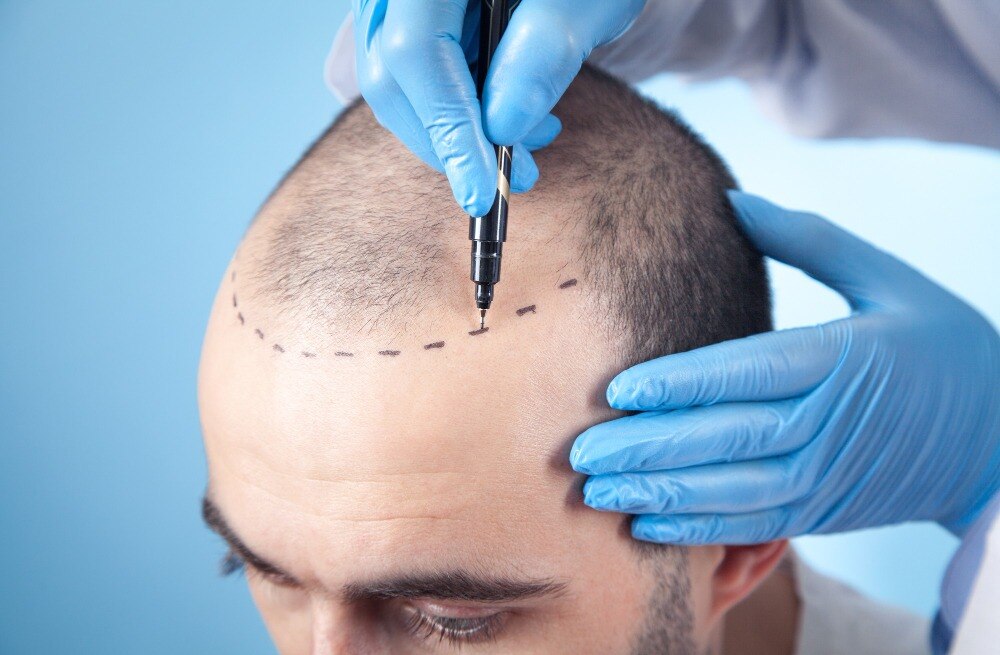
An age-appropriate hairline sits above the lowest possible forehead position, with gentle irregularity rather than a ruler-straight edge. Lowering it too far consumes donor hair and can look unnatural when age-related thinning continues.
Natural hairline design starts with facial proportions, current loss, family-pattern risk and the donor supply available for later procedures. Single-hair follicular units form the leading edge; two- and three-hair units sit farther behind it to build density without creating a pluggy line.
Graft planning treats “grafts” and “hairs” as different measurements. One graft may contain one, two, three or more hairs, so a quoted graft number cannot be compared fairly without its average hair count.
The surgeon adjusts placement for:
- Donor-area density and the amount that can be removed without visible depletion
- Hair calibre, curl, colour contrast with the scalp and follicular-unit size
- Recipient-area size, existing native hair and the pattern of expected future loss
- Scalp characteristics and the density that the donor area can realistically support
The target is coverage that looks balanced, not adolescent density. Packing more grafts into a thin area can waste limited donor follicles without producing a proportionate visual improvement. Native hair can continue to miniaturise, while transplanted follicles retain donor-region characteristics, so the plan should preserve reserves and address ongoing loss when appropriate.
At Finesse Aesthetic, ask to see the proposed hairline drawn from front and side views, the estimated graft count, the expected hairs-per-graft ratio and the donor reserve after surgery.
Related service
SURGICAL TREATMENTS Transform your hairline and regain confidence with our advanced Hair Transplant - Scalp (FUE) procedure at Finesse Aesthetic. View service → |
What should you expect after surgery, and how do you protect the result?
Expect scalp tightness, pain, swelling, itching, crusting and numbness during hair transplant recovery. Swelling often peaks around days two to four; crusts usually loosen within 7 to 14 days. Transplanted hair shedding commonly occurs during the first several weeks, but the follicles remain in place.
New visible growth usually begins after three to four months, and assess the cosmetic result at 12 months or later.
- Follow the clinic’s washing, sleeping and activity instructions. Do not scratch crusts, pick scabs, wear tight headwear or resume strenuous exercise until cleared.
- Protect the recipient and donor areas from direct sun while the skin heals. Ask when you can safely swim, use hair products or undergo chemical treatments.
- Discuss minoxidil if preserving native hair is part of your plan. Ask whether finasteride suits you; it is prescription treatment for male pattern hair loss, requires ongoing use for benefit and must not be used during pregnancy because of fetal risk.
- Seek prompt medical review for spreading redness, pus, fever, worsening pain, persistent bleeding, severe swelling, or a wound opening. Poor growth, visible scarring or an unnatural hairline can require revision surgery.
- Plan for continued native-hair thinning. Donor follicles resist androgenetic miniaturization better than susceptible scalp hair, but a transplant does not guarantee a fixed density or stop future loss.
Frequently asked questions
Is hair loss permanent enough for a transplant?
Patterned loss with a stable donor area at the back and sides is the usual transplant target. A diagnosis is needed before deciding.
What does a proper candidacy assessment measure?
Assessment reviews the cause and pattern of loss, donor density, hair calibre, scalp health, age, medical history, and likely future thinning.
Should you choose FUE or FUT for hair transplantation?
FUE removes individual follicular units, while FUT removes a strip of scalp. Compare scarring, recovery, graft requirements, donor supply, and surgical time.
How are hairline density and graft numbers planned?
Planning considers facial proportions, existing hair, donor reserves, hair calibre, loss pattern, desired density, and the possibility of future hair loss.
What should you expect after hair transplant surgery?
Expect a healing period, temporary shedding of transplanted hairs, gradual regrowth, and aftercare instructions. Protect the result by following them and managing ongoing loss.