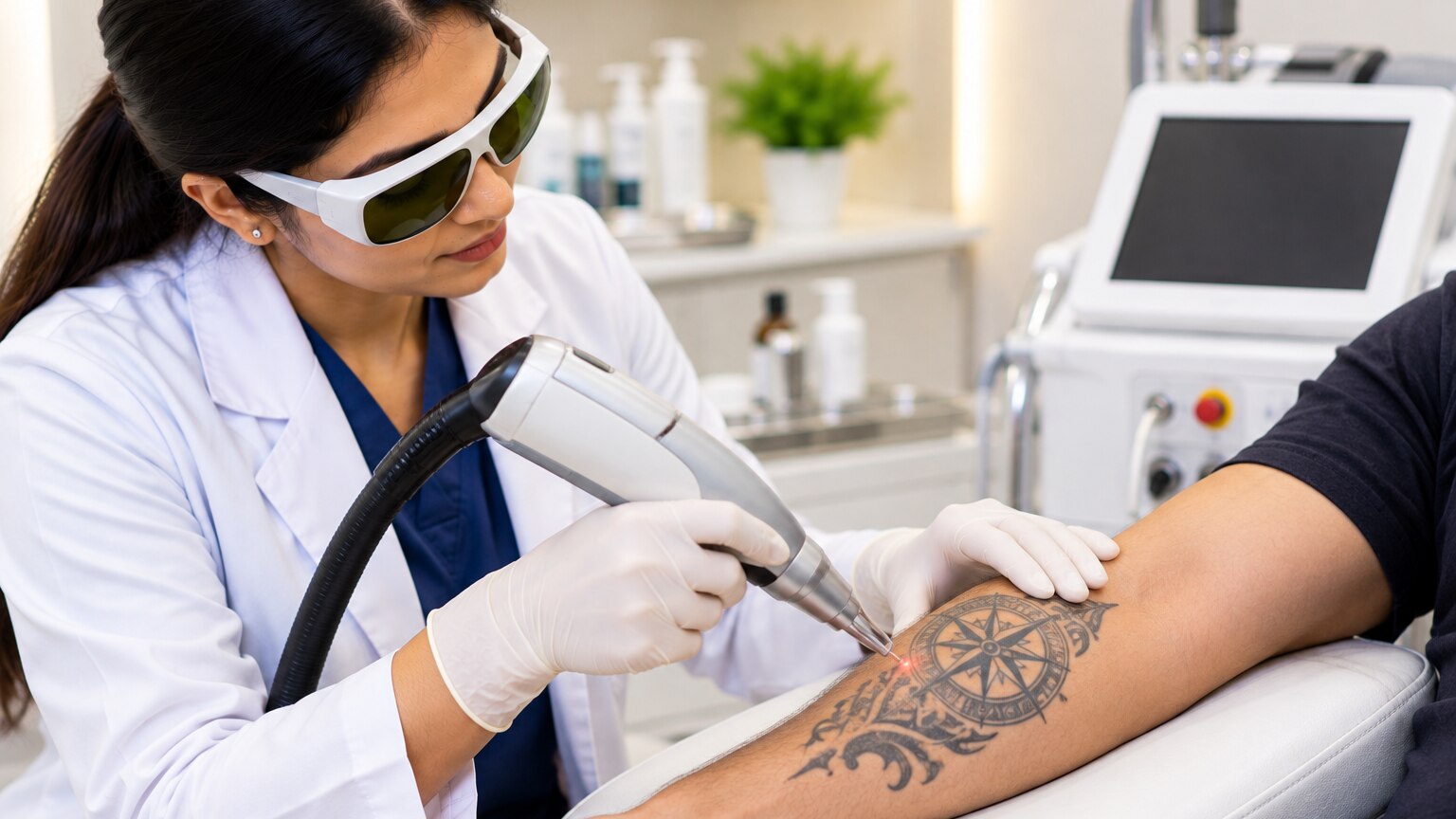
Fading an unwanted tattoo depends on its ink colours, depth, density, location and your skin’s healing response—not simply on how powerful the laser is. You will be able to compare laser types, estimate the treatment timeline, prepare for each appointment and recognise the risks that deserve a clinician’s attention.
Key takeaways
- Match the wavelength to ink colour, depth and tattoo type.
- Expect multiple sessions because ink particles clear gradually between treatments.
- Avoid tanning and disclose medicines, skin conditions and recent treatments.
- Ask about test spots, realistic fading and risks of pigment changes.
Which laser wavelength and pulse type matches your tattoo?
The right laser tattoo removal wavelengths depend on ink colour, pigment depth and whether the tattoo is professional, amateur or cosmetic. Black and dark-blue pigment commonly suit a 1,064-nm Nd:YAG laser, making 1064 nm tattoo removal a frequent starting point.
| Option | Main target or role | What changes the choice |
|---|---|---|
| 1,064 nm Nd:YAG | Black and dark-blue ink | Deep pigment, darker skin and the need for conservative settings |
| 532 nm | Many red and orange pigments; some yellow | Surface pigment, skin colour and the ink’s exact chemistry |
| 755 nm | Selected green and blue pigments | Pigment shade, depth and response after earlier sessions |
| 694 nm | Selected green and blue pigments | Ink chemistry and the clinician’s available laser system |
| Q-switched | Very short, high-energy pulses for many conventional tattoos | Useful when established pigment responds to rapid fragmentation |
| Picosecond | Even shorter pulses for certain resistant or densely packed pigments | Does not replace choosing the correct wavelength |
For 532 nm tattoo removal, the clinician may change to another wavelength as red or orange ink fades and deeper colours become visible. Selected cases suit 755 nm laser tattoo removal, while 694 nm systems can address other green or blue pigments.
A multicolour tattoo rarely needs one wavelength only; spot size, fluence and pulse duration can also change between sessions.
Ask which wavelength is planned for each colour, whether a test spot is needed and how settings will change as the design fades. “Picosecond” alone does not prove that the treatment matches your tattoo.
Why does tattoo removal take several sessions?
Several tattoo removal sessions are needed because the laser breaks up ink; it does not remove the ink at the appointment. Short, high-energy pulses fragment larger particles into smaller pieces and trigger a controlled inflammatory response.
That is how laser tattoo removal works: the immune system clears tattoo ink gradually, with other clearance processes carrying fragments away through the body. The skin also needs time to settle before another treatment can safely deliver more energy.
1. Immediately after treatment, the tattoo may look nearly unchanged because the ink is still in the skin. Redness, swelling or other short-term inflammation does not mean the pigment has disappeared.
2. During the following weeks, the design may become lighter, less saturated or uneven as pigment clears at different rates. Allow at least 6–8 weeks between tattoo removal treatments; wait longer when healing is slow or clearance is still progressing.
3. At the next appointment, the clinician treats part of the remaining pigment. Professional tattoos often contain dense, deeply deposited ink, so one session cannot safely break down everything without increasing the risk of burns, scarring or lasting pigment changes.
Spacing appointments protects the skin while giving your body time to clear the fragments. Treating too soon adds energy to tissue that has not settled and does not force faster fading. Expect progress over months rather than judging the result immediately after each session.
What determines how quickly an unwanted tattoo fades?
Ink colour is one of the strongest factors affecting tattoo removal: black often responds well, while white, flesh-coloured, pastel and some yellow pigments can resist treatment or turn grey, brown or darker before fading.
1. A professional versus amateur tattoo is not a simple difficulty test. Professional ink is usually deeper, denser and more uniform; a dense amateur tattoo or unusual pigment can be just as stubborn. Large, saturated designs need more treated skin and more appointments.
2. Location, age and healing affect the pace. Ink on areas with slower circulation can clear less quickly than ink on well-perfused sites, while an older tattoo is not automatically easier to remove. Tell the clinician how much you smoke: tattoo removal smoking can slow healing and reduce clearance.
3. Set expectations before treatment. Scarring or altered texture can change treatment settings and the final appearance, and tattoo removal scars and residual pigment can leave a ghost image, colour change or textural change; complete removal is not guaranteed.
Excision can remove a small tattoo in one procedure, but it replaces the design with a surgical scar. Dermabrasion removes or injures upper skin layers and also risks scarring. Laser treatment aims to preserve surrounding skin, accepting a longer process and repeated appointments.
How should you prepare for a laser tattoo removal session?
Preparing for laser tattoo removal starts with sun avoidance before tattoo removal: keep the tattoo covered from direct sun and stop tanning before your appointment. Recently tanned skin contains extra melanin, which competes with the laser and increases the risk of burns, lighter marks and darker marks.
1. Tell the clinician about every medicine and supplement you take, each medical condition, any history of poor wound healing and previous reactions to tattoo treatment. This information can change the treatment plan or aftercare.
2. Ask whether topical anaesthetic tattoo removal is suitable for the tattoo’s size and location. Use only the product and timing the clinician approves; apply and remove it exactly as instructed rather than using an unapproved cream.
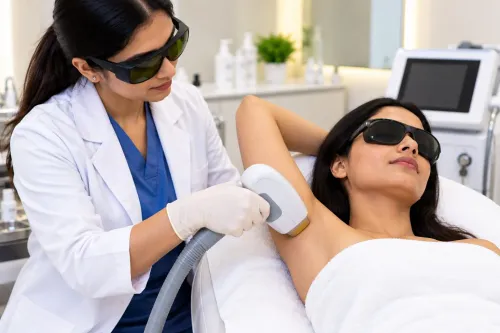
3. Wear the wavelength-specific protective eyewear provided during treatment. Cooling can reduce heat and discomfort, but the laser may still feel like repeated elastic-band snaps. A small tattoo can take minutes; a large or multicolour design takes longer.
4. Expect redness, swelling, pinpoint bleeding, blistering or crusting after treatment. Keep the area clean, follow the wound-care instructions and do not pick blisters or scabs.
Good tattoo removal aftercare reduces infection, scarring and pigment changes. Contact the treating clinician if pain worsens, redness spreads, discharge appears or healing is delayed.
How can you reduce the risk of an unexpected result?
Reduce unexpected results by treating the consultation as a safety check, not a choice between laser brand names. Ask for a written plan before treatment begins, with each ink colour, proposed wavelength and expected interval between sessions identified.
1. Ask which pigment is being treated at each appointment and why that wavelength fits it. Confirm the planned interval, usually at least 6–8 weeks, so the skin can heal and pigment clearance can continue.
2. Request a laser tattoo removal test spot when pigment composition is uncertain. This is especially important for permanent makeup and cosmetic tattoos: iron oxide or titanium dioxide can turn grey or black after exposure, creating cosmetic tattoo laser darkening that may need further treatment and may not fully reverse.
3. If you have darker skin, ask about conservative settings and strict sun protection. Tattoo removal darker skin carries a higher risk of post-inflammatory hyperpigmentation and hypopigmentation, and a test spot can expose an excessive inflammatory response before the full design is treated.
4. Ask how the clinician will check for scarring, altered texture and pigment changes after every session. Do not proceed without clear instructions for protecting the area between appointments.
5. While choosing a tattoo removal clinic, compare the clinician’s assessment, test-spot policy, aftercare instructions and explanation of realistic fading—not a promise of complete removal.
If you are considering Finesse Aesthetic in Chennai, take a clear photograph of the tattoo and use these questions during the consultation. A ghost image or residual colour can remain even after appropriate treatment.
Related service
At Finesse Aesthetic, we offer state-of-the-art tattoo removal services designed to help you erase unwanted ink with precision and care. View service → |
Frequently asked questions
Which laser wavelength matches my tattoo?
Black and dark-blue ink commonly suit a 1,064-nm Nd:YAG laser. Other ink colours require wavelength selection based on their pigment and depth.
Why does tattoo removal take several sessions?
Laser energy breaks tattoo pigment into smaller particles, and your body clears those particles between sessions. Multiple treatments address the remaining ink gradually.
What determines how quickly an unwanted tattoo fades?
Ink colour, pigment depth, tattoo size, ink density, professional or amateur application, skin type and the interval between sessions all affect fading speed.
How should I prepare for laser tattoo removal?
Avoid tanning, tell the clinician about medicines and skin conditions, and discuss recent treatments before the appointment. Follow the clinic’s instructions for clean, untreated skin.
How can I reduce the risk of an unexpected result?
Ask which wavelength and pulse type will be used, request a test spot when appropriate, and discuss incomplete fading, scarring and temporary or lasting pigment changes before treatment.